In short
Almost every leak that is not a slipped tile is a leadwork leak. Chimney flashings, valleys, abutments, back gutters and parapet outlets are where water finds its way in, and they are the parts most often sealed with mastic by somebody hoping it will hold.
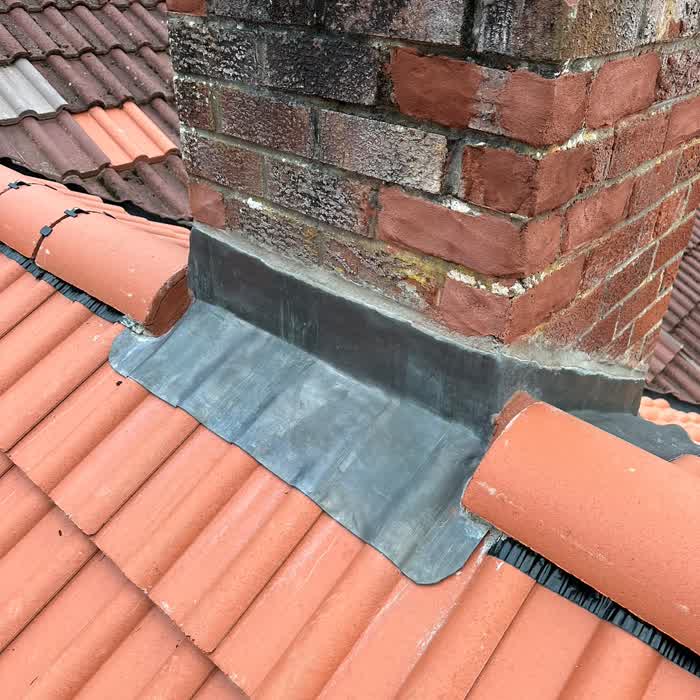
Signs you need roof drainage and leadwork
- A damp patch on a chimney breast that comes back every winter
- Mastic or flashband visible around a chimney or against a wall
- A split or crack along the fold of a lead valley
- Staining on the ceiling where a flat roof meets the main wall
- Water appearing after driving rain but not after gentle rain
- A parapet or box gutter that overflows inward
What the job involves
Trace the actual entry point
Leadwork leaks travel. The wet patch inside is often a long way from where the water is getting in.
Strip the failed detail out
Old mastic, flashband and cement fillets all come off. They are not repairs, they are postponements.
Dress new lead to fit the roof
Cut to the right code for the job and worked to the shape of what is actually there, on the roof, rather than folded flat and forced into place.
Chase and wedge it in properly
Into a raked joint, wedged and pointed, so it is held by the building rather than glued to it.
Check the drainage path
A perfect flashing above a blocked outlet still floods. We follow the water all the way off the roof.
Want someone to take a look?
Send a photograph of the problem and you will get a straight answer on what it needs, at no cost.
Roof Drainage and Leadwork near you
Frequently asked questions
Why is mastic not good enough?
It is a sealant, and sealants move and crack while lead does not. Every mastic repair has a life of a few years at best, and it usually hides the problem long enough for the timber underneath to rot.
What is a cement fillet?
A wedge of mortar used instead of lead where a roof meets a wall. It cracks as the building moves, water gets behind it, and it is one of the most common causes of a chimney leak we are called to.
Can lead be repaired or does it need replacing?
Lead lasts a very long time and can often be re-dressed. Splits along a fold usually mean the sheet was too long and had nowhere to expand, and that wants replacing properly rather than patching.
Is lead theft still a risk?
It happens, though far less than it did. Where a roof is exposed and accessible we can talk about alternatives or about marking it.
Why is this page called roof plumbing?
That is the term used in some countries for drainage and flashing work, and it is the address this page has always had. In the UK you would usually just call it leadwork.